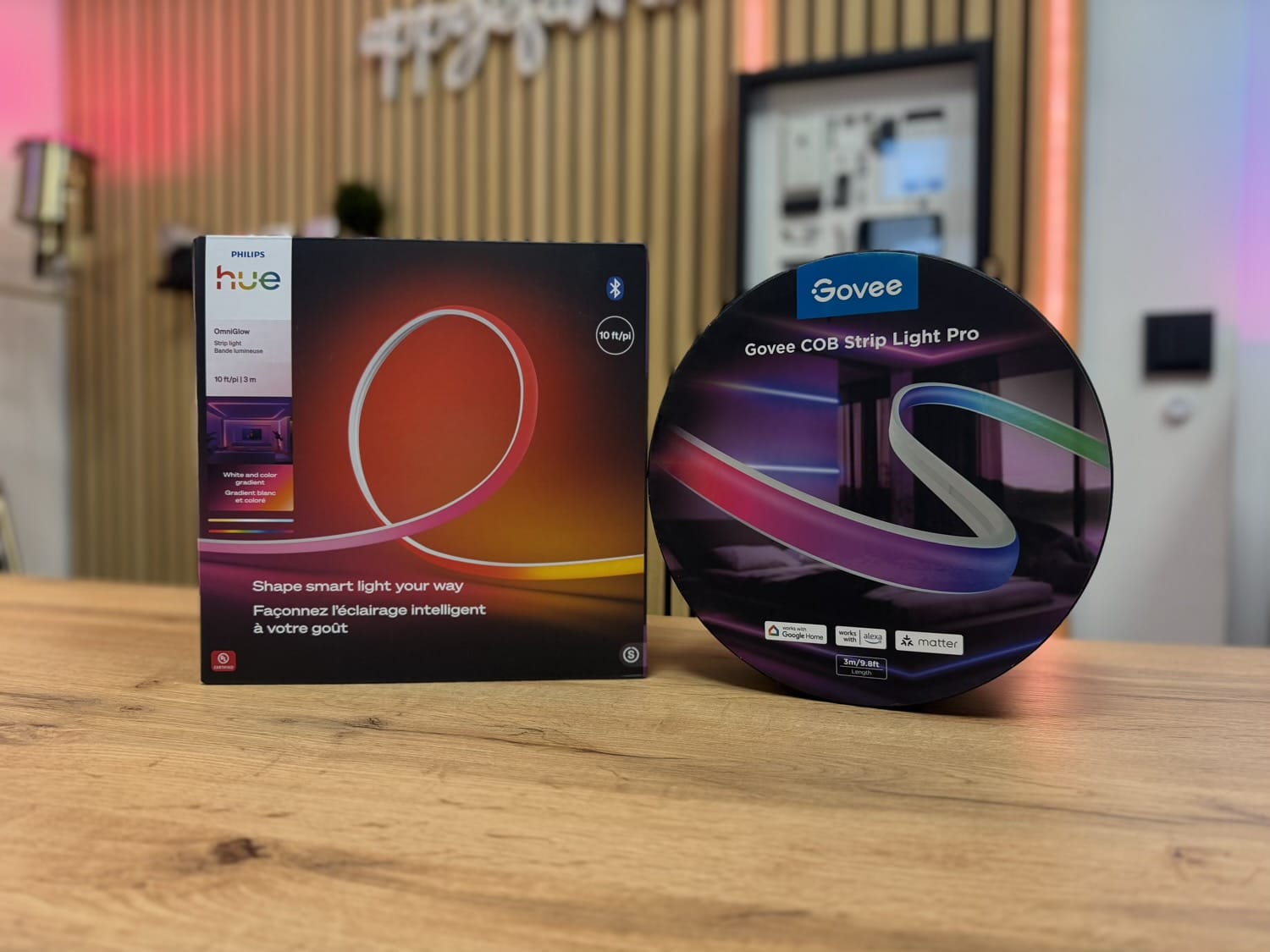
Philips Hue costs roughly four times more per bulb than Govee. That’s the honest starting point for this comparison. The question is whether Hue is four times better — and the answer depends entirely on what you’re asking the lighting to do.
The Real Price Comparison
Before getting into specifications, the full cost picture matters:
Philips Hue starter kit (bridge + 4 bulbs): $150–200, then $49/bulb for additional A19 color.
Govee RGBIC starter (4 bulbs): ~$48 (4-pack), no hub required.
For 10 bulbs in a living room and two bedrooms:
- Hue: $200 (kit) + 6 additional bulbs × $49 = ~$494
- Govee: ~$120 total (three 4-packs)
That’s a $374 difference for equivalent bulb count. Both will light your home.
What You Get at the Hue Price
Thread-native reliability: Hue bulbs communicate via Thread (with a Matter-compatible setup) or via Zigbee through the Hue Bridge. Thread provides sub-20ms response time and local processing that doesn’t require internet. Govee uses Wi-Fi, which adds latency and creates a single point of failure.
Entertainment sync: Philips Hue’s sync box technology ties lighting to on-screen content at 50+ updates per second. For movie watching and gaming, this creates an ambient effect no Govee product replicates. This requires the Hue Play HDMI Sync Box ($299) in addition to Hue bulbs.
10-year software support track record: Hue bulbs from 2014 still receive firmware updates in 2026. Govee’s older products sometimes lose app support when the company moves to a new platform. If you’re building a permanent home installation, Hue’s longevity argument is real.
Ecosystem depth: Hue works with Apple Home, Google Home, Alexa, Samsung SmartThings, and dozens of third-party apps via the Hue API. The developer community has built extensive integrations. Govee’s ecosystem is narrower — primarily the Govee app with Alexa and Google integration.
Check Current Price on Amazon (paid link)
What You Get at the Govee Price
RGBIC technology: Govee’s RGBIC bulbs produce multiple colors from a single bulb simultaneously — something no standard Hue A19 does. For decorative, accent, and entertainment lighting, the visual results per dollar are dramatically better with Govee.
Music sync built into the bulb: Many Govee products include a microphone for real-time music sync — the bulb responds to audio in the room without requiring an external sync box. The Hue equivalent requires a $299 HDMI sync box purchase.
No hub required: Govee connects directly to Wi-Fi. Philips Hue’s full feature set requires the Hue Bridge ($60) or the newer Thread/Matter setup.
Dramatically lower barrier to experimentation: At $12/bulb, trying Govee in a room and deciding it doesn’t suit the space costs less than a single Hue bulb. The risk profile is fundamentally different.
Check Current Price on Amazon (paid link)
Head-to-Head Comparison
| Feature | Philips Hue | Govee | HTR Take |
|---|---|---|---|
| Price per A19 bulb | $49 | $12 | Govee wins |
| Thread connectivity | Yes | No (Wi-Fi) | Hue wins |
| Response latency | 15ms (Thread) | 100–300ms (Wi-Fi) | Hue wins |
| Multiple colors per bulb | No (A19) | Yes (RGBIC) | Govee wins |
| Entertainment sync | Hue Sync Box ($299 extra) | Built-in mic | Govee wins (at price point) |
| Ecosystem integration | 15+ platforms + API | Govee app + Alexa/Google | Hue wins |
| Software support longevity | 10+ years documented | 3–5 years typical | Hue wins |
| No hub required (Matter) | Yes (with Thread setup) | Yes | Tie |
| Color accuracy | Very high | High (RGBIC varies) | Hue wins |
The Specific Use Cases Where Each Wins
Govee is the right choice for:
- Accent and decorative lighting where visual drama matters more than latency
- Rooms where you want to try smart lighting before committing to a full installation
- Holiday and seasonal lighting where you want rich color effects at minimal cost
- Music and entertainment sync without buying a separate HDMI sync box
- Bedrooms and playrooms — not stairwells and critical-automation spaces
Hue is the right choice for:
- Primary living spaces where you’ve built automations that run constantly
- Any room where reliability and response time matter (entrance lights, security-triggered lighting)
- Multi-device synced lighting (all lights in a room or zone acting together without lag)
- Home theaters with HDMI content sync
- Long-term installations where you want to avoid replacing products in 5 years
Frequently Asked Questions
Can I mix Hue and Govee in the same home?
Yes, but they won’t work in the same automation as a single group. Hue lights are in the Hue ecosystem (or Apple Home/Google Home); Govee lights are in the Govee ecosystem. You can have Govee in the bedroom (accent use) and Hue in the living room (automation use) — they just operate independently.
Does Hue work without the Hue Bridge?
Yes, with Matter/Thread setup. Newer Hue bulbs with Thread radios pair directly with Apple TV 4K, HomePod mini, or Google Nest Hub as a Thread border router without the Hue Bridge. The Bridge is still useful for Zigbee-only bulbs and for the Entertainment sync feature.
How long do Govee bulbs typically last?
Owner reports at the 24–36 month mark show Govee bulbs typically functioning well mechanically — the hardware holds up. The more relevant concern is software support: older Govee apps are sometimes replaced with new versions that don’t support legacy devices. Check the Govee community before buying older product lines.
HTR Verdict
- Buy Govee if you want vibrant decorative lighting, music sync, or RGBIC multi-color effects without the Hue premium. The visual results per dollar are genuinely better.
- Buy Hue if you're building always-on automation (arrival/departure, presence-triggered, TV sync) or primary room lighting where Thread reliability and 10-year software support justify the cost.
- Bottom line: Most households benefit from both — Hue in automation-critical locations, Govee in accent and entertainment roles. The "which one" framing misses that they serve different purposes better than either does alone.